Imam Ahmed Rida Khan [d. 1340h/1921 CE] was a champion of the Sunni World in the twentieth century as he defended the belief system of Sunni Muslims and rejected the false and deviant ways head on with support from the greatest Ulama worldwide.
He restored the deen to its original state in India when falsehood was being mixed with the truth and people were confused about Sunni beliefs and practices. Such a person is known as a “Mujaddid”.
Hadrat Umar (may Allah be pleased with him) narrates the Messenger of Allah (peace and blessings upon him) said:
“There will always be in my Ummah a group who safeguard the truth until Qiyamah comes” [Hakim’s Mustadrak]
Hadrat Abu Hurayrah (may Allah be pleased with him) narrates the Noble Prophet (upon him peace and blessings) said:
“Allah shall send for this Ummah at the head of every hundred years a person who shall revive their Deen for them”
Family History
Imam Ahmed Rida son of Mufti Naqi ‘Ali son of Mufti Muhammad Rida. He was born in a scholarly family on the 10th of Shawwal (1856 CE) in Bareilly, India.
His forefathers were originally from Kandahar, Afghanistan, and migrated to and settled in India.
Studies & Discipleship
Imam Ahmed Rida studied twenty one traditional Islamic sciences under his father, and mastered over fifty traditional sciences most of which were poured into his heart from Allah Almighty as he mentioned in al-Ijaazat al-Mateenah.
He wrote his first ever fatwa on 14th Sha’ban 1286h on an issue of fostering (when he was only 13 years, 10 months and 4 days old!)
Imam Ahmed Rida took his spiritual pledge (bay’ah/ahd) and received khilafah in various Sufi pathways from his spiritual teacher , Sayyid Shah Aal-e-Rasul Ahmadi from Marehrah, India, in 1296H.
Travels to Hajj
First Hajj: In 1295h (1878 CE), at the age of 22, the great Imam traveled to perform Hajj with his father where he received Ijazahs (licenses to teach) in the traditional sciences from the great scholars of Makkah such as Sayyid Ahmad Zayni Dahlan and Mufti Abdullah bin Abd ar-Rahman Siraaj.
Event: It is narrated that Imam Ahmed Rida was near Maqam Ibrahim after Maghrib salah one evening that the Shafi’I Imam of Masjid al-Haraam Shaykh Salih Jamal al-Layl Makki (d.1320h/1884) greeted him and said: “I swear by Allah, I can see the light of Allah shine in your forehead” and presented Ijazahs to him.
Second Hajj: In 1323h (1906 CE), Imam Ahmed Rida travelled to the Two Holy sanctuaries for the second time in company of his brother, Mawlana Hassan Raza Khan and son, Mawlana Hamid Raza Khan.
Event: He wrote a book called “Al-Dawlah al-Makkiyyah” in Arabic in this journey in just over eight hours without using any books on a question proposed to him by the Sharif of Makkah on the Noble Prophet ‘s (may Allah give him peace and blessings) knowledge of the unseen (ilm al-gayb). This work received a tremendous acceptance in its recital gathering in the presence of the Sharif which was attended by the prominent scholars of the time.
In the same journey, he had numerous meetings of knowledge and circles with the great Ulama who were either teaching, living or traveling in Hijaz. He produced a number of books in Arabic due to these sittings and circles, among them are:
Hussam al-Haramayn (Sword of the Two Holy Sanctuaries on the throat of disbelief and falsehood) – his famous work in defence of the Sunni beliefs and refutation of deviant groups that had blasphemed Allah and His Messenger.
Al-Ijaazat al-Mateenah – His licenses to the scholars of Makkah and Madinah and letters to them
Kiflul Faqih – Fatwa on the legal status of the bank note in Islamic law
All three of the above mentioned books made Imam Ahmed Rida very popular in the holy lands of Hijaz, Syria and Yemen.
Major scholars of Makkah and Madinah praised him lavishly for his knowledge and piety. He was called:
“The absolute Shaykh of all teachers” by Shaykh Ismail Makki, Libarian of Makkah Haram Library
“The encyclopaedia of all sciences” by Shaykh ‘Ali bin Hassan Maliki, Mufti of Makkah city
“A giant Imam and well learned man who is an expert in the sciences” by Shaykh Yusuf Nabhani, Mujaddid of Sham & Mufti of Lebanon.
[See: Al-Dawlah al-Makkiyyah & Hussamul Haramayn for more]
His Principles (Manhaj)
1. Love of Allah and His Messenger is before anything & everything
He said “If my heart was ever divided into two parts, one of them would have written on it “laa ilaaha illAllah” and on the other “Muhammadur Rasulullah”!!
2. Defending the Honour of the Noble Messenger (upon him peace & blessings)
He did not tolerate blasphemy (disrespect) of the Noble Messenger or of the pious companions or Awliya and stood strongly against the corrupted groups of his time for this reason.
3. Education and transmission of authentic knowledge
He was a dedicated teacher and some of the greatest Ulama of India were his students, among them are:
4. Self-Purification
He followed the spiritual path (tariqa) of Shaykh Abdul Qadir Jilani and loved all the Sufiya (Awliya). He made thousands repent from sins in his gatherings and his entire life was spent purifying hearts and summoning people to Allah Almighty
5. Praise of the Messenger through writing and poems
His Durood-o-Salam is recited all over the world after Jum’ua and at the ends of religious events in mosques and homes like the Qasidah Burdah. His most famous book of Na’ats is called “Hada’iq-e-Bakshish” containing some of the finest praises of Allah and of His chosen people.
6. Following the Sunnah of the Messenger (upon him peace & blessings) to the smallest detail
The character of the Noble Messenger (upon him peace & blessings) was imprinted in Imam Ahmed Rida’s life. He staunchly practised the Sunnah and so did his disciples and students.
7. Uncompromising defence of the Ahlus-Sunnah beliefs and practises
He authored more than two hundred books on the teachings of the Ahlus-Sunnah and their defence.
His Books
Imam Ahmed Rida wrote more than a thousand books and commentaries in more than 55 sciences. A list of about 350 books is available titled “al-Mujmal al Mu’addid”. A bulky 12 volume Hanafi fatwa collection: “Fataawa-e-Ridwiyyah” in Urdu/Arabic was recently published in Lahore (Pakistan) with an index in 33 volumes! His Fataawa are an ocean of knowledge and wisdom.
The Sunni Muslims of the sub-continent (India, Bangladesh, Pakistan and Afghanistan) remember the great Imam for his service to the Ahlus-Sunnah and consider him a saviour when the Sunni-way was at threat.
His Demise and Burial
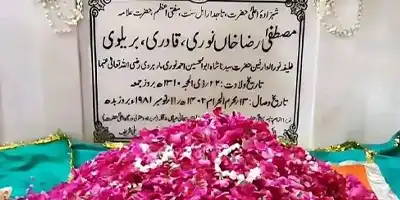
Imam Ahmed Rida passed away on 28th October 1921 CE (25th Safar 1340h) at the age of 65, in his home at Jumu’ah time when the mu’adhin was saying “come to success” leaving behind two sons, Mowlana Hamid Raza and Mufti Mustafa Raza, and five daughters.
People from all over the world visit his blessed shrine in Bareilly Shareef every year on 25th Safar and attend the annual khatam (Blessed URS).
The great grandson who takes care of the affairs of the school of Imam Ahmed Rida in Bareilly is Mufti Akhtar Rida Khan, a fine scholar and graduate of al-Azhar University in Egypt. He is now visually impaired yet still teaches and dictates translations to books in Arabic and English, with good knowledge of English. May Allah preserve him and grant health.