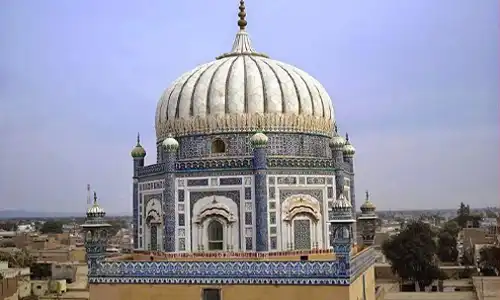
Is it legally valid in Islam to visit the graves and seek blessings from them? To answerthis question, we shall consider the belief of the Noble Prophet Sayyidina Muhammad(sallallahu ‘alaihi wasallam) and the scholars of this ummah.The belief of the dear Prophet (sallallahu ‘alaihi wasallam)
Commenting on this hadith, the renowned Muhaqqiq, Shaykh Abdul Haq Dehlwi writes that because the period of ignorance had just passed, Rasoolallah (sallallahu ‘alaihi wasallam) forbade the visitation due to fear of the Muslims returning to their old ways. However, when the people became well acquainted with the orders of Islam, then the dear Prophet (sallallahu ‘alaihi wasallam) allowed the visitation to take place (Ashi’atul Lum’aat, vol.1 p.717).
From these ahadith, it is clear that according to the dear Prophet (sallallahu ‘alaihiwasallam), visitation of the graves is permissible. Moreover, that person who visits hisparents’ graves every Friday, his sins will be forgiven.
The belief of Imam Shafi’i (radiyallahu ta’ala anhu) (d. 204 H)Allama ibn Abideen Shaami (rahmatullah `alaih – d. 1253 H) writes that Imam Shafi’i(radiyallahu ta’ala anhu) said:“I seek blessings from Abu Haneefa and go near his grave. When I am need of somethingI perform two raka’ahs of salah and then I go near his grave and pray to Allah. Thus, myneed is fulfilled quickly” (Raddul Muhtar, vol.1 p.38)
Also, Shaykh Abdul Haq Dehlwi writes:
“Imam Shafi’i said that the grave of Hadrat Musa Kaazim (radiyallahu ta’ala anhu) is aplace where supplications are accepted readily” (Ashi’atul Lum’aat, vol.1 p.715)
From these writings, it is found that the belief of Imam Shafi’i was that to go to the gravesof the pious and to seek blessings from them, to offer supplications near them graves andto believe the occupant of the grave to be a means of removing difficulties is totallypermissible. The Imam also believed that some of these graves are a place wheresupplications are accepted.
The belief of Allama Sawi Maliki (radiyallahu ta’ala anhu) Commenting on the verse “And seek a means of approach to him” (5:35),
Imam Sawiwrites: “To say that Muslims who visit the graves of the saints are Kafir because you believe they are worshipping other than Allah is a signof clear heresy. To visit the saints is not worshipping other than Allah, rather it is a sign of loving those whom Allah loves” (Tafseer Sawi, vol.1 p.245)
From this commentary, we learn that according to Imam Sawi, visiting the graves of thesaints is permissible, it is not worshipping other than Allah but it is loving those whomAllah loves.
The belief of Khwaja Hamiduddin Nagori (radiyallahu ta’ala anhu) (d. 677 H) The great Sufi Shaykh, Hamiduddin Nagori, said that whoever has a need that he needs tobe fulfilled, he should go to the grave of my wife, Sayyidah Khadijah, and seek blessingsthere because she never turned anyone away (Sultan at-Tarikeen, p.93)
From these words of Khwaja Hamiduddin, we discover his belief that the chosen peopleof Allah can help people even from their graves. Muslims should go to the graves of thechosen servants of the Creator and seek the benefits from them.
The belief of Sultan al-Mashaikh Nizam ad-Din Awliya (radiyallahu ta’ala anhu) (d.725 H)
Hadrat Nizam ad-Din Awliya (radiyallahu ta’ala anhu) says that Maulana Katheli oncenarrated a story about himself. Maulana Katheli said that one year, a famine stuck Delhi.I was passing by a marketplace when I felt hungry. I bought some food and said tomyself, I should not eat this alone, I should find someone to share it with. I saw an oldman who had a cloak wrapped around his body. I said to him, “Oh Khwaja! I am poor and you too look poor”. He then invited the old man to eat with him who accepted theinvitation. Whilst we ate, Maulana Katheli narrated, I told him that I was in debt for twenty rupees.Hearing this, the old man urged me to continue eating and promised that he would go andget twenty rupees for me. I thought to myself, where is he going to get this sum from?After eating, the old man got up and took me to the mosque. In the mosque was situated agrave. He went near the grave and asked for something. He had a small stick in his handwhich he used to hit the grave twice and he then said that this man needs twenty rupees, give it to him. He then turned towards me and said, “Maulana, go back, you shall findyour twenty rupees”.
When I heard this, I kissed the old man’s hand and headed back to the city. I wasdumbfounded as to where I will find the twenty rupees. I had a letter with me which I hadto deliver to someone’s house. I took this letter to where it had to be delivered and saw aTurkish man there. He ordered his servants to take me upstairs. I tried hard but could notrecognise him even though he kept saying that I was the one who once helped him. I saidI did not recognise him but he said he recognised me. We talked like this for some time. He then came to me and placed twenty rupees in my hand. (Fawaid al-Fawaad, p.124)
From this story narrated by Hadrat Nizam ad-Din Awliya, we learn that his belief was that the way in which saints can help us in their Earthly lives, they can also help us from beyond the grave and asking them is permissible. The real bestower is Allah and the saints help us through Allah’s command just like the real curer of illnesses is Allah but the patient asks the doctor to cure him.
The belief of Allama Jaami (radiyallahu ta’ala anhu) (d. 898 H) Allama Jaami writes that Shaykh Abul Harith Awlasi (rahmatullah `alaih) said that he had heard much about Hadrat Dhunnun Misri (`alaihir rahmah war ridwan). To clarify a few queries (mas’alas), I intended to visit him. When I got to Egypt I was informed that Hadrat Dhunnun had passed away. Hearing this, I went to his grave and sat in muraqabah. A while later, I felt tired and went to sleep. I saw Hadrat Dhunnun Misri in my dream and asked him my questions. He replied to my questions and relieved my burden. (Nafhatal-Uns, p.193)
By writing this incident, Allama Jaami has made clear his belief that to go to the shrines of the saints with a need is permissible. The saints help us through the power bestowed upon them by Allah.
The belief of Imam ibn Hajar Makki ash-Shafi’i (radiyallahu ta’ala anhu) (d. 973 H) Imam ibn Hajar Makki writes that it has always been the practice of the scholars and those who need to go to the shrine of Imam Abu Haneefa (radiyallahu ta’ala anhu) and seek the intermediation of the Imam to remove their difficulties. These people believed this to be a means of success and received great rewards from this practice. Imam Shafi’i, whenever he was in Baghdad, would go to the shrine of Imam Abu Haneefa and seek blessings from him. Whenever I am in need, I offer two rak’ahs of salah and then go near his grave. I pray to Allah at this place, hence, my difficulty is immediately removed. (Al- Khairat al-Hissan, p.166)
From this writing, it is ever clear that Imam ibn Hajar Makki believed that to go to shrines of the pious people and seek their waseela (intermediation) is permissible and Imam Shafi’i was a practitioner of this method. The belief of Shaykh Abdul Haq Dehlwi (radiyallahu ta’ala anhu) (d. 1052 H)
The Shaykh writes: “To visit graves is by consensus a mustahab (preferable) action” (Ashi’atul Lum’aat, vol.1, p.715) He also writes: “When visiting the dead, respecting them is Wajib (necessary) especially where the pious are concerned. As it was necessary to respect them whilst they were alive, similarly, it is important to show them respect at their graves. This is because the help which the pious give depends on the respect that people who visit them show to them” (Ashi’atul Lum’aat, vol.1 p.720)
From these writing, it is absolutely manifest that the belief of Shaykh Abdul Haq was that to visit the graves is neither Shirk nor Bid’ah. Moreover, it is a preferable act and the visitor is blessed with the help of the inmate of the grave.
The belief of Sayyid Ahmad Tahtawi (radiyallahu ta’ala anhu) (d. 1231 H) Imam Tahtawi writes: “Elderly women are allowed to visit the graves and gather blessings from them as long as they do not commit any act there that is contrary to the Shari’ah. This is impermissible for young ladies the same as it is not allowed for them to attend the mosque for Jama’ah. The conclusion is that women are only allowed to visit the graves if they are sure that no fitna will occur” (Tahtawi `ala Miraqi, p.341)
Hence, we learn that Imam Tahtawi believed that men can seek blessings from the shrines and women are only allowed to do so when no fitna will occur.
The belief of Imam ibn Abideen Shaami (radiyallahu ta’ala anhu) (d. 1253 H) Imam Shaami writes: “Saints hold differing ranks in the court of Allah and to those who visit them, they benefit them through their spiritual stations” (Raddul Muhtar, vol.1 p.604)
The Imam also writes: “For elderly women, there is not harm for them to seek the blessings from the graves of the pious. However, for young women, it is not allowed like it is not allowed for them to go to the mosque for Jama’ah” (Raddul Muhtar, vol.1 p.604) From these writings of the Imam, he has made his belief totally clear that according to their rank, saints gift their visitors with benefit and blessings. It is permissible for elderly women to seek blessings from the shrines of the pious but not for the younger women. The belief of Shah Waliullah Dehlwi (radiyallahu ta’ala anhu) (d. 1176 H) Shah Waliullah writes that his father, Shah Abdur Raheem, said that he once went to the shrine of Hadrat Khwaja Qutbuddin Bakhtyar Kaaki (rahmatullah `alaih). The soul of Bakhtyar Kaaki became apparent and told me that I shall have a son and that I should name him Qutbuddin Ahmad. At this time, my wife had become elderly and was beyond child bearing age. On hearing this, I thought to myself that maybe I shall have a grandson. The soul of Bakhtyar Kaaki got to know of my thinking and removed my doubt and said that it did not give me tidings of a grandson, rather, this child will be my very own. Some time later, I married again and from this marriage was born (Shah) Waliullah. At the time of my birth, my father had forgotten about this event and named me Waliullah. When he came to recall this event, he gave a second name of Qutbuddin Ahmad. (Anfaas al-`Arifeen, p.110)
By writing about this incident, the belief of Shah Waliullah Dehlwi is clear. He believed that to go to the shrines of the pious ispermissible and even after their demise, the saints are still given the knowledge of the unseen because Qutbuddin Bakhtyar Kaaki knew about the birth of a son a year before it happened. Also, the inmate of the grave also knew the feelings of his visitor’s heart.
The belief of Shah Abdul Azeez Dehwli (radiyallahu ta’ala anhu) (d. 1239 H) Shah Abdul Azeez writes: “It is in Sharh Maqasid that visiting graves is beneficial and the souls of the pious cause benefit. Indeed, after death the soul has a connection with the body and the grave. Hence, when someone comes to visit this shrine and turns towards the soul of the inmate, then the two souls (of the visitor and the inmate) form a connection. It is a point of contention whether the help of the living is stronger or that of the deceased. Some scholars have said that the deceased can help more and some have proved this from a narration from the dear Prophet (sallallahu ‘alaihi wasallam) that when you need help in a matter, seek it from the people of the grave. The great Shaykh, Shah Abdul Haq Dehlwi (rahmatullah `alaih) has stated in Sharh Mishkat that there is nothing in the Qur’an and Sunnah nor the sayings of the Salaf which contradicts this position and forms a proof against it. (Fatawa Aziziya, vol.2 p.108)
From this excerpt from the Fatawa of Shah Abdul Azeez, it is evident that to visit the graves of the pious is a meritorious act and to seek help from the person of the grave is totally permissible in the Shari’ah.
Reference: https://theahlesunnah.wordpress.com/2012/06/10/seeking-blessings-from-the-graves-of-the-pious/